July 7, 2026 · 7:27 AM
July 7: structures outlive founders
A July 7 business-history briefing on four structures that outlived their originators: American Express traveler’s cheques, Hawaii’s annexation route, sliced bread, and Hoover Dam’s contracting model. The throughline is value distribution: mechanisms can scale long after the people who launched them lose control of the upside, the legitimacy cost, or the operating risk.

The useful pattern in July 7's business-history record is not invention for its own sake. The thing that scales is often the structure, not the founder's intent: a financial trust mechanism, a legal route, a product format, and a contracting model.
The business mirror is less about invention than distribution. Each decision created a repeatable mechanism. Each mechanism then moved value, power, or risk away from the person who first pushed it into the world.
1891: American Express turns trust into a product
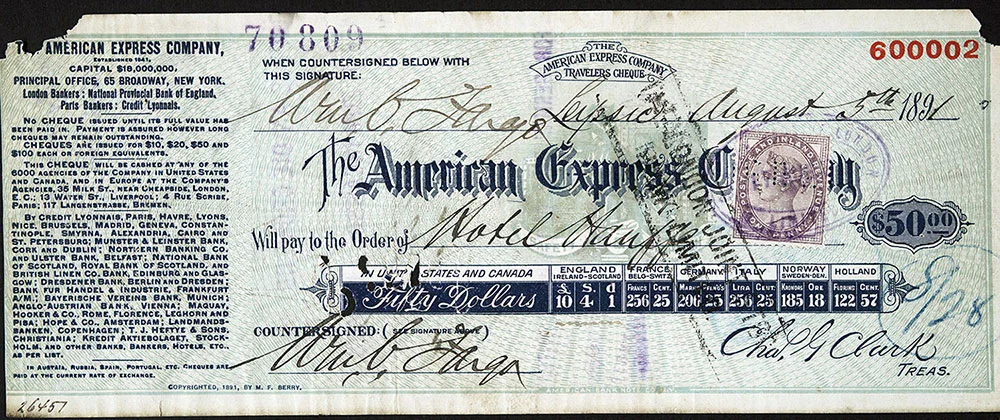
Marcellus F. Berry, an American Express employee, received U.S. copyrights 24775 through 24778 on July 7, 1891, for a traveler's cheque design built around a two-signature requirement. 1 The buyer signed once when purchasing the cheque and again when cashing it, giving the merchant a simple way to compare signatures before accepting payment. 2
The problem came from a senior executive's frustration. American Express president James C. Fargo had trouble using letters of credit while traveling in Europe, and the company needed a portable payment instrument that would be more acceptable across borders. 3 The first American Express traveler's cheques were issued in $10, $20, $50, and $100 denominations, and one early cheque was cashed at Hotel Hauffe in Leipzig, Germany. 2
The product's real power was float. Customers paid cash upfront, held the cheques until they needed them, and gave American Express a pool of money that could sit inside the company before redemption. American Express traveler's cheque sales reached $32 million in 1913, $522 million in 1945, and $1.6 billion in 1958. 4 By the end of 1995, outstanding unredeemed balances stood at $5.7 billion. 4
The product also shows how a business model can expire after a long winning run. American Express stopped selling traveler's cheques on December 31, 2020, after credit cards, debit cards, and ATMs had made the instrument less necessary for most travelers. 4
Decision mirror: If a product makes trust easier to verify, the mechanism may be more valuable than the object. The cheque was paper; the business was prepayment, acceptance, and float.
1898: Hawaii shows the cost of a shortcut that works
McKinley signed the Newlands Resolution on July 7, 1898, using a joint resolution of Congress to annex Hawaii to the United States. 5 The House had passed the measure 209-91 on June 15, 1898, and the Senate had passed it 42-21 on July 6, 1898. 6
The legal architecture mattered because a treaty would have required a two-thirds Senate vote. The joint-resolution route gave annexation supporters another path after treaty politics had stalled. 5 For U.S. sugar interests, annexation promised a way back into the American market after the 1890 McKinley Tariff damaged Hawaii's earlier sugar advantage. 7 For U.S. strategists, the Spanish-American War made Hawaii's position in the Pacific more valuable after Admiral George Dewey's victory at Manila Bay on May 1, 1898. 7
The business reading cannot stop at market access and naval logistics. The monarchy had been overthrown on January 17, 1893, Queen Liliuokalani had been deposed, and Sanford B. Dole led the provisional government that followed. 8 Native Hawaiian opposition was substantial: the anti-annexation petitions of 1897-1898 carried 21,269 signatures, more than half of an estimated Native Hawaiian population of about 39,000. 8
The long arc widened the gap between strategic success and legitimacy. Hawaii became the 50th U.S. state on August 21, 1959. 8 President Bill Clinton signed Public Law 103-150, the Apology Resolution, on November 23, 1993, formally acknowledging U.S. involvement in the overthrow of the Hawaiian Kingdom. 8
Decision mirror: A shortcut can solve the immediate constraint and still create a balance-sheet item no accountant records. When legitimacy is the unpaid cost, the liability can last longer than the strategic win.
1928: sliced bread makes format the innovation
Chillicothe Baking Company in Chillicothe, Missouri, began selling Kleen Maid sliced bread on July 7, 1928, using Otto Frederick Rohwedder's bread-slicing machine. 9 Rohwedder had been a jeweler before he turned to the bread problem, and a 1917 factory fire destroyed his first prototype and much of his work. 10
The product did not change the recipe. It changed the use case. Pre-sliced bread lowered the effort of making toast and sandwiches, but the slices also went stale faster unless packaging kept pace. Rohwedder's later system combined slicing and wrapping, which made the format commercially workable rather than merely clever. 11
Historic Missouri's local history account reports a 2,000% sales increase within two weeks of the launch. 9 Continental Baking Company adopted the technology for Wonder Bread in 1930, and sliced bread sales in U.S. bakeries exceeded unsliced bread sales in 1933. 12
The category's dependence on the new format became visible during a shortage. The U.S. Office of Price Administration banned sliced bread on January 18, 1943, and the ban was withdrawn on March 9, 1943, after public backlash. 12 The phrase "the greatest thing since sliced bread" became a cultural benchmark for useful innovation, but the economics were harsher for the early operators. Rohwedder sold his patent to Micro-Westco and became a vice president there, while Chillicothe baker Frank Bench lost his bakery during the Great Depression. 12
Decision mirror: A format change can beat a product change when it removes daily friction. The hard question is who captures the value once the format becomes normal.
1930: Hoover Dam starts with coordination, not concrete
Wilbur sent the July 7, 1930, order that preliminary work could begin on the Boulder Canyon Dam project, later named Hoover Dam, and The New York Times reported the next day that the instruction had gone by telegraph from Washington. 13 14 The early work covered enabling infrastructure such as railroad access, roads, and Boulder City, while the main dam contract work followed in 1931. 15
The project became a model of risk aggregation. Six Companies, Inc. was a special-purpose construction consortium formed for the work, with members including Henry J. Kaiser and Bechtel interests, MacDonald & Kahn, Morrison-Knudsen, Utah Construction Company, J.F. Shea, and Pacific Bridge Company. 16 Fortune later described the group as capitalized at $8 million, bidding $48,890,995, and bonding the contract with $5 million in cash. 16
The delivery record was extraordinary and costly. Hoover Dam was completed on March 1, 1936, more than two years ahead of schedule. 15 Over five years, about 21,000 people worked on the project, with peak employment of 5,251 workers. 14 More than 100 workers died during construction. 14 The infrastructure that resulted created Lake Mead, supplied hydroelectric power, supported downstream flood control, and helped enable the growth of Las Vegas and irrigated agriculture in the Southwest. 14
The lesson is in the first move. The visible monument came later; the July 7 decision was about mobilizing the system around the job before concrete placement became the headline.
Decision mirror: Large projects fail first in coordination, financing, and risk allocation. The dam's physical scale mattered, but the contracting structure made that scale executable.
July 7 is a reminder that structures travel farther than origin stories. The founder, president, baker, or secretary may trigger the action, but the durable result is the mechanism others can repeat: a trust protocol, a legal route, a product format, or a contracting machine.
Cover image: 1891 American Express traveler's cheque, via Smithsonian National Postal Museum.
References
- 1Numismatic News: Coming demise of traveler's checks
- 2Smithsonian National Postal Museum: American Express
- 3ABA Banking Journal: Nine Young Bankers Who Changed America - Marcellus Flemming Berry
- 4TheStreet: History of American Express: Company timeline and facts
- 5National Archives: Joint Resolution to Provide for Annexing the Hawaiian Islands
- 6Teaching American History: The Annexation of Hawaii
- 7Bill of Rights Institute: The Annexation of Hawaii
- 8White House Historical Association: Hawai'i and the White House
- 9Historic Missouri: Chillicothe Missouri Baking Company Bakery
- 10MIT Lemelson Program: Otto Rohwedder
- 11Smithsonian National Museum of American History: Bread-slicing Machine
- 12KCUR: A Missouri town almost forgot it invented sliced bread
- 13The New York Times: Work is started at Boulder Dam
- 14HISTORY.com: Preliminary work begins on the Hoover Dam
- 15Bureau of Reclamation: Hoover Dam chronology
- 16Bureau of Reclamation: Hoover Dam - Fortune Magazine
Related content
- Sign in to comment.